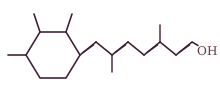
Also known as
Main function
Retinol speeds up skin cell turnover and supports collagen production. It's one of the most studied anti-aging and acne-supporting ingredients in skincare — and one of the more fragile ones to store and formulate correctly.
What does this mean for melanin-rich skin?
Retinol speeds up cell turnover, helping shed PIH, dark marks, and uneven patches while boosting collagen for smoother texture. The catch is specific to melanin-rich skin: irritation itself triggers more melanin production, so burning or flaking from retinol can make dark spots worse instead of better — the opposite of what you're using it for.
If your skin is already sensitive, reactive, or prone to eczema, talk to a dermatologist before starting retinol on your own. It's also worth skipping prescription-strength retinoids like Retin-A at the beginning — they're often too strong for darker skin to tolerate right away. Don't skip sunscreen either: retinol increases UV sensitivity, and missing SPF can trigger the exact hyperpigmentation you're trying to treat. Patch test on your inner arm or jaw for 2–3 nights before using it on your full face.
Evidence
Cell turnover / PIH fading Clinical
Retinoids have shown measurable reduction of dark marks in clinical trials, though results build gradually over weeks to months.
Irritation-triggered hyperpigmentation risk Clinical
Retinoid-related irritation is a documented risk factor for new PIH specifically in skin of color — this is the core trade-off to manage, not a reason to avoid retinol altogether.
How does climate affect this?
Retinol is genuinely fragile — heat, light, and air all degrade it. Research directly comparing light and heat exposure found light causes the faster breakdown of the two, even faster than heat alone. In a hot climate, that means both storage and container matter more than usual: keep it in a cool, dry spot away from direct sun, and favor products in opaque or dark glass packaging, since clear bottles let light degrade the retinol before you've even used half the bottle.
Key considerations
- — Light exposure, not just heat, is the bigger threat to a retinol product's potency — where you keep the bottle matters as much as how hot it gets.
- — A degraded retinol product doesn't turn harmful, but it does lose effectiveness — you may simply stop seeing results without knowing why.
What can you actually check?
Every cosmetic sold in Nigeria is legally required to carry a NAFDAC number. Check yours on NAFDAC's NAPAMS portal — no result, or a completely different product, is your answer.
Real retinol products are almost always packaged in opaque, airtight, or dark glass containers — never a clear bottle or an open jar you dip fingers into, since both light and repeated air exposure ruin retinol fast. If a "retinol" product comes in a clear container, that's a formulation red flag on its own, regardless of whether it's counterfeit — a well-formulated retinol product simply wouldn't be packaged that way.
- Starting concentration
- 0.25 – 0.3%
- Starting frequency
- 2 nights a week, building up slowly
- Buffer method
- Moisturizer → retinol → moisturizer ("sandwich method")
- Best time of use
- PM only, with SPF the next morning
Avoid combining retinol with AHAs/BHAs, benzoyl peroxide, or Vitamin C in the same routine — layering multiple actives raises irritation risk without adding proportional benefit. Best for most skin types when introduced slowly; go especially slow on sensitive or reactive skin.
The claims on this page draw on the following sources. Each is linked to what it supports, not cited generally.
-
Irritation and PIH risk in skin of color
Callender VD, Baldwin H, Cook-Bolden FE, Alexis AF, Stein Gold L, Guenin E. Effects of Topical Retinoids on Acne and Post-inflammatory Hyperpigmentation in Patients with Skin of Color: A Clinical Review and Implications for Practice. Am J Clin Dermatol. 2022;23(1):69–81. -
Light vs. heat degradation
Retinol degradation kinetics under heat and UV light exposure — data presented at a Society of Cosmetic Chemists Annual Scientific Meeting, published via the Journal of Cosmetic Science research archive.
This list will grow as each new claim on the site is checked against its source. If you spot a claim without a listed source, that's a gap to flag — not evidence it's wrong, but a page waiting on its citation.
Sourcing tier: specific cited studies.
At a glance: INCI Retinol · Vitamin A / cell-turnover · Oil-soluble · Common in serums, night creams · PM only · Last reviewed September 2026