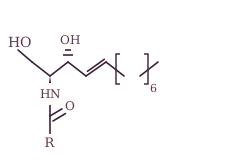
Also known as
Main function
Ceramides are lipids naturally found in the skin barrier, holding skin cells together and sealing in moisture. Topical ceramides top up what skin already makes, supporting a barrier that's under stress.
What does this mean for melanin-rich skin?
Melanin-rich skin tends to lose more moisture through the barrier, and studies report it often starts out lower in natural ceramides too. That leaves the barrier a bit more fragile — and it matters more than comfort: when the barrier gets irritated, melanocytes respond by overproducing pigment. That's usually the real cause behind post-inflammatory hyperpigmentation (PIH), the dark marks left after a breakout or bump.
Keeping ceramide levels topped up helps interrupt that irritation-to-dark-mark cycle before it starts, instead of just fading spots after the fact. Patch test any new formulation first, since an already-stressed barrier tends to react more.
Evidence
Lower baseline ceramide levels Clinical · Limited
Reviewed literature reports Black skin tends to have the lowest ceramide content among studied ethnic groups, alongside higher susceptibility to moisture loss.
Barrier irritation → PIH Mechanistic
The link between barrier irritation and new dark marks is well-established dermatological mechanism, not unique to ceramide specifically.
How does climate affect this?
Heat and sweat put real stress on the skin barrier, and air conditioning indoors can quietly pull moisture out too, even when it's hot outside. Ceramide as a raw ingredient holds up well through both — how a finished ceramide product performs in heat still depends on its full formulation, not the ceramide alone.
Pairing ceramide with a humectant like hyaluronic acid or glycerin keeps hydration up without feeling heavy. In peak heat, a lightweight gel-cream or lotion tends to sit better than a thick butter. And ceramides support the barrier — they're not a substitute for sunscreen.
Key considerations
- — Raw ingredient stability and finished-product performance in heat are two different things — check the specific product's texture and feel, not just the ingredient name.
- — Pairing with a humectant and choosing a lighter texture in hot weather is a formulation choice, not a sign a heavier product is "wrong."
What can you actually check?
Every cosmetic sold in Nigeria is legally required to carry a NAFDAC number. Check yours on NAFDAC's NAPAMS portal — no result, or a completely different product, is your answer.
The surest check: flip to the ingredients list and look for an actual named ceramide, like Ceramide NP or Ceramide AP. If the front label says "ceramide" but none show up in the ingredients, it's likely marketing only. Bottles that have visibly separated or smell off are also worth a second look — though texture and feel vary by formula, so they're a caution, not proof either way.
- Typical formulation pH
- 4.5 – 5.5
- Concentration range
- 0.5 – 5%
- Common concentration used
- ~1–2%, ideally paired with cholesterol & fatty acids (~3:1:1 ratio)
- Best for
- All skin types, especially dry, mature, or barrier-compromised skin
- Best time of use
- AM or PM — especially useful in a PM repair routine
The claims on this page draw on the following sources. Each is linked to what it supports, not cited generally.
-
Baseline ceramide levels and moisture loss
Wesley NO, Maibach HI. Racial (ethnic) differences in skin properties: the objective data. Am J Clin Dermatol. 2003;4(12):843–860.
View on PubMed →
This list will grow as each new claim on the site is checked against its source. If you spot a claim without a listed source, that's a gap to flag — not evidence it's wrong, but a page waiting on its citation.
Sourcing tier: specific cited study (Wesley & Maibach 2003) plus general formulation chemistry.
At a glance: INCI Ceramide (various types) · Barrier lipid · Common in creams, lotions, repair balms · AM or PM · Last reviewed September 2026